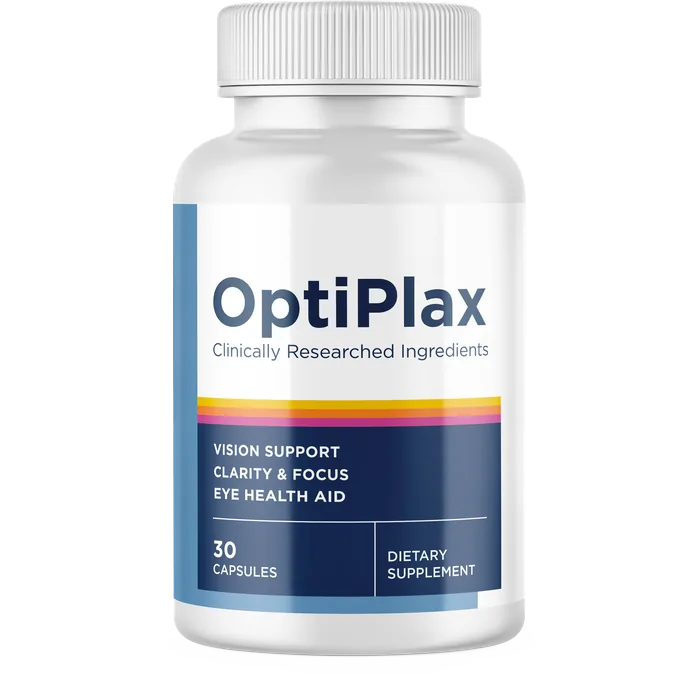
OptiPlax is a seaweed-and-algae capsule wrapped in a dramatic story about an "optical plaque" that clouds your vision and can be flushed out. The label is published, which is more than many brands offer, and the price, one-time payment and 60-day guarantee are standard for the category. But the formula contains none of the nutrients from the National Eye Institute's AREDS2 trials, the plaque theory is not an accepted cause of blurry vision, and kelp brings an iodine question for anyone with a thyroid condition. It is a hard product to recommend for eyesight.
What we like
- The full Supplement Facts label is published on the site
- One capsule a day, simple routine
- One-time payment, no autoship
- 60-day refund that accepts empty bottles
Keep in mind
- None of the AREDS2 eye nutrients (lutein, zeaxanthin, zinc, vitamins C and E)
- "Optical plaque" and "clears the gunk" claims are not supported
- 500 mg blend with no amount per ingredient
- Kelp iodine is a concern with thyroid conditions; email-only support; you pay return shipping
Check OptiPlax price on the official site →Opens the brand's official website · money-back guarantee
OptiPlax is sometimes searched as Opti Plax or Optiplax eye supplement; it is the same product sold on theoptiplax.com.
OptiPlax is a daily eye capsule marketed to adults who feel their vision has become blurry, strained or dull with age. The site says "plaque" builds up in the delicate tissues of the eye and that its formula supports "the natural cleansing processes of the eye". The label shows what is actually inside: a 500 mg blend of kelp, wakame, astaxanthin, chlorella, Ecklonia cava, fucoxanthin, nori, spirulina and sea buckthorn oil. You take one capsule a day. It is sold through theoptiplax.com at $49 to $79 per bottle as a one-time payment, with a 60-day money-back guarantee. This review explains what the label means, how it compares with the research benchmark for eye supplements, what it costs and how the refund works.
First, what an eye supplement can and cannot do
Most blurry vision is an optical problem, not a nutritional one. Nearsightedness, farsightedness, astigmatism and the reading trouble that starts in your 40s (presbyopia) happen because the eye focuses light in the wrong place, and glasses, contacts or surgery correct that. No capsule changes the shape of your eye or makes the lens flexible again.
Where nutrition does matter is the long-term health of the retina, and even there the strongest evidence is narrow: a specific vitamin-and-mineral formula slows one disease, age-related macular degeneration, in people who already have it at a certain stage. That is the realistic ceiling for any eye supplement.
And before anything else: sudden blurry vision, a curtain or shadow over part of your sight, a burst of new floaters or flashes, eye pain or sudden loss of vision in one eye are emergencies. See an eye doctor or go to an emergency room the same day. A sudden loss of vision in one eye can also be a warning sign of stroke.
What is inside OptiPlax?
The brand publishes its Supplement Facts panel. Here is what it lists:
| Supplement Facts (per capsule) | Amount |
|---|---|
| Proprietary blend: kelp powder (leaf), wakame extract (leaf), astaxanthin 2% (Haematococcus pluvialis algae), chlorella powder, Ecklonia cava brown seaweed extract, kelp extract (Laminaria japonica, standardized to 10% fucoxanthin), nori yaki powder, spirulina powder, sea buckthorn oil | 500 mg total (no amount per ingredient) |
| Other ingredients | Gelatin (capsule), brown rice flour, silicon dioxide |
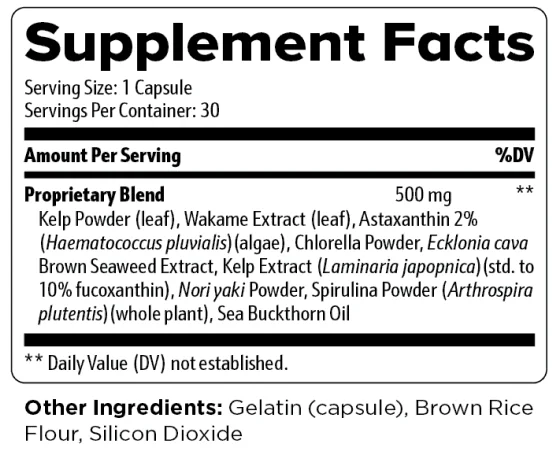
Two things stand out. First, every active ingredient sits inside one 500 mg proprietary blend, so you cannot tell how much of each one you get. Second, the astaxanthin is a 2% extract: even if the entire 500 mg blend were that extract, a capsule would hold at most 10 mg of pure astaxanthin, and because it shares the space with eight other ingredients, the real figure is almost certainly far lower. Here is each ingredient next to what research supports.
| Ingredient | What the brand says | What research supports |
|---|---|---|
| Kelp (powder and extract) | Sea minerals that help "cleanse" eye tissue | No human trials for vision. Kelp is a concentrated, variable source of iodine, which matters for the thyroid. |
| Fucoxanthin (from kelp, 10% extract) | Seaweed antioxidant | Studied mostly in the lab and in animals; no trials for eyesight. |
| Astaxanthin (2% algae extract) | Powerful antioxidant for the retina | Small studies, mostly Japanese, looked at eye fatigue and retinal blood flow. Not part of the AREDS2 formula; no proof it sharpens vision. |
| Ecklonia cava | Supports blood vessels and nerve cells | The studies the brand cites are in cells and animals, not in human eyes. |
| Wakame, nori | Nourishing sea vegetables | Common foods; no vision trials as supplements. |
| Chlorella, spirulina | Detox and nutrient support | Algae supplements with general nutrition research; no trials for eyesight. Chlorella contains vitamin K. |
| Sea buckthorn oil | Nourishes the eye | A few small studies on dry eye; evidence is limited. |
Every ingredient, up close
Here is every active ingredient on the label, what it actually is, and what research does and does not show.

Kelp (powder and fucoxanthin extract)
Kelp leaf powder plus kelp extract (Laminaria japonica, standardized to 10% fucoxanthin). In a 500 mg blend, amount not disclosedKelp is a large brown seaweed, sold dried in Japan as kombu, and it appears twice on this label: as plain leaf powder and as an extract standardized for fucoxanthin, a brown seaweed pigment. Fucoxanthin has been studied mostly in the lab and in animals, and there are no human trials of kelp for vision. The practical issue is iodine: kelp is a concentrated, variable source, and the label does not say how much a capsule supplies.
Photo: Alice Wiegand, ( Lyzzy ) / CC BY-SA 3.0, via Wikimedia Commons
Wakame extract (leaf)
In a 500 mg blend, amount not disclosedThe silky seaweed found in miso soup, another brown alga that naturally contains fucoxanthin and iodine. It is a nutritious food, but it has not been tested as a supplement for eyesight.
Photo: Fumikas Sagisavas / CC0, via Wikimedia Commons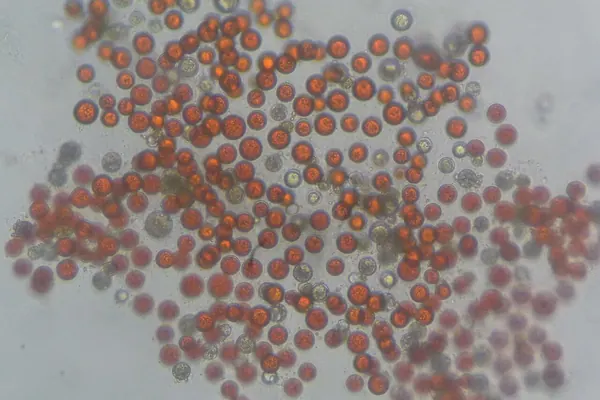
Astaxanthin 2% (Haematococcus pluvialis)
In a 500 mg blend, amount not disclosedA red pigment made by the freshwater microalga Haematococcus pluvialis, shown here under a microscope, and related to lutein and zeaxanthin. Small, short studies, many from Japan, looked at eye fatigue after screen work and retinal blood flow, usually at around 6 to 12 mg a day, with suggestive but limited results. Because this is a 2% extract sharing a 500 mg blend with eight other ingredients, even the theoretical maximum is 10 mg, and the real amount is almost certainly far lower.
Photo: Lucia Cimarelli / CC BY 4.0, via Wikimedia Commons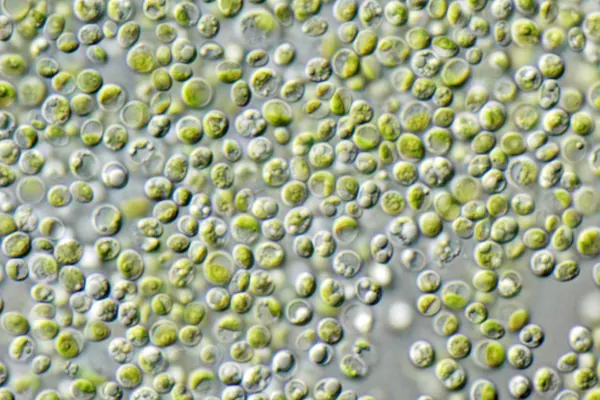
Chlorella powder
In a 500 mg blend, amount not disclosedA single-celled green freshwater alga, pictured here as cells under a microscope, sold as a "detox" powder. It has general nutrition research but no trials for eyesight, and it contains vitamin K, which matters for people on warfarin.
Photo: ja:User:NEON / User:NEON_ja / CC BY-SA 3.0, via Wikimedia Commons
Ecklonia cava brown seaweed extract
In a 500 mg blend, amount not disclosedAn edible brown seaweed from the coasts of Korea and Japan, rich in polyphenols called phlorotannins (pictured: a pressed museum specimen). The studies the brand cites were done in cells and animals, not in human eyes.
Photo: Naturalis - Botany catalogues / CC0, via Wikimedia Commons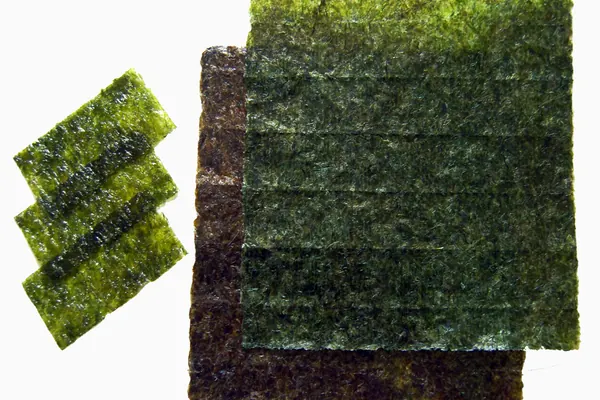
Nori yaki powder
In a 500 mg blend, amount not disclosedToasted red seaweed, the same sheets used to wrap sushi ("yaki" means roasted). It is a common food that adds a little iodine and plant pigment; it has no vision trials as a supplement.
Photo: Alice Wiegand, ( Lyzzy ) / CC BY-SA 3.0, via Wikimedia Commons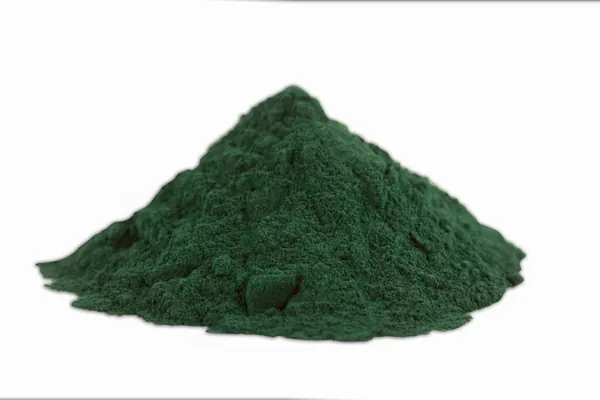
Spirulina powder
In a 500 mg blend, amount not disclosedA blue-green microalga (technically a cyanobacterium) sold as a protein and nutrient powder. Its research covers general nutrition, not eyesight, and people with autoimmune conditions are usually advised to ask a doctor before taking it.
Photo: Music4thekids / CC BY-SA 3.0, via Wikimedia Commons
Sea buckthorn oil
In a 500 mg blend, amount not disclosed (last on the label)Oil from the bright orange berries of a hardy shrub, rich in omega-7 fats and carotenoids. A few small studies have looked at it for dry eye, with limited evidence, and as the last ingredient in the blend its amount is likely small.
Photo: Jaana Siitonen / CC BY 4.0, via Wikimedia CommonsThe "optical plaque" story
The marketing claims that a toxic "Optical Plaque" forms "like rust" on the retina, and that OptiPlax "clears the gunk that's been stealing your sight for years". The references page explains where the idea comes from: studies on microplastics found on the eye's surface and in the vitreous gel of the eye, a 2011 study that found amyloid plaques in the retinas of people with Alzheimer's disease, a 1961 paper on cholesterol plaques in retinal arteries, and lab studies showing that seaweed can bind metals.
Each of those is real research, but none of them shows that "plaque" is why ordinary people need reading glasses, and none tested seaweed for removing anything from a human eye. Some of the references are about other topics entirely, such as skin wrinkles in mice and global plastic production. One point deserves emphasis: the cholesterol plaques that doctors do see in retinal arteries are tiny clots that broke off from a larger artery, usually in the neck. They are a warning sign of stroke risk, and the right response is an urgent medical workup, not a supplement.
Check OptiPlax price on the official site →Opens the brand's official website · money-back guarantee
The benchmark: the AREDS2 eye-vitamin formula
When people ask whether an eye supplement "works", the fair comparison is the formula tested by the National Eye Institute in the AREDS and AREDS2 trials. In people who already had intermediate age-related macular degeneration (AMD), or advanced AMD in one eye, it lowered the risk of progressing to advanced AMD by about 25% over five years. These are the daily amounts it used, and how OptiPlax compares:
| Nutrient | Daily amount used in AREDS2 | In OptiPlax? |
|---|---|---|
| Vitamin C | 500 mg | ❌ Not listed |
| Vitamin E | 400 IU | ❌ Not listed |
| Zinc | 80 mg | ❌ Not listed |
| Copper | 2 mg | ❌ Not listed |
| Lutein | 10 mg | ❌ Not listed |
| Zeaxanthin | 2 mg | ❌ Not listed |
OptiPlax shares none of these six nutrients. That does not make it dangerous, but it means the one body of strong evidence for eye supplements does not apply to it. It is also worth knowing what AREDS2 did not show: it did not improve eyesight, did not prevent AMD in people with healthy eyes and did not slow cataracts. So even the best-studied formula does not do what the OptiPlax testimonials describe, such as passing a driver's vision test without glasses.
How to take OptiPlax
The label says one capsule a day with 6 to 8 oz of water, and the contact page suggests the morning. Astaxanthin and sea buckthorn oil are fat-soluble, so taking it with a meal is a sensible habit. Do not exceed the label dose, and if you already take a kelp, iodine or multivitamin supplement, check with your doctor before adding another source of iodine.
How much does OptiPlax cost?
The official order page sells three packages, each a single charge. The FAQ says there is no autoship or hidden fee.
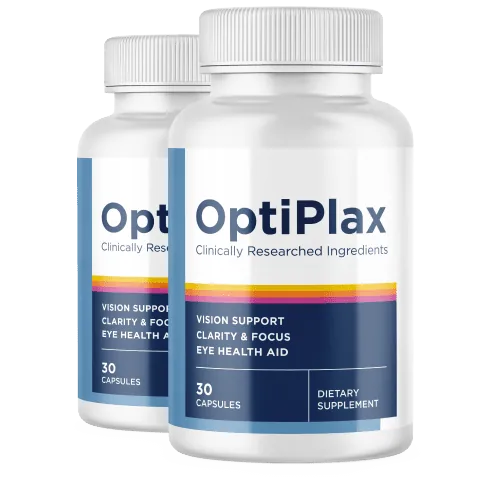 2 bottles60-day supply$79 /bottle$158 · + $9.99 shippingCheck availability →Best value
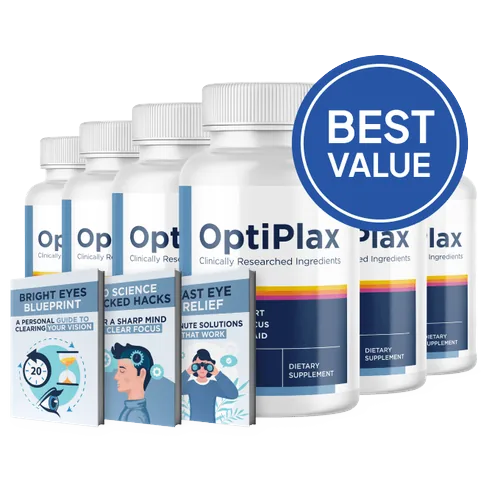 6 bottles180-day supply$49 /bottle$294 · free US shipping + 3 e-booksCheck availability →
 3 bottles90-day supply$69 /bottle$207 · free US shippingCheck availability →
| Package | Supply | Price per bottle | Total | Extras |
|---|---|---|---|---|
| 2 bottles | 60-day supply | $79 | $158 | + $9.99 shipping |
| 6 bottles | 180-day supply | $49 | $294 | free US shipping + 3 e-books |
| 3 bottles | 90-day supply | $69 | $207 | free US shipping |
Prices as listed on the official order page when we checked. They change from time to time, so the checkout page is the final word.
About shipping: the order page adds $9.99 shipping to the 2-bottle package and shows free shipping on 3 and 6 bottles, while the text page says free shipping comes with every 6-bottle order. The shipping table lists the US as free with delivery in 5 to 7 working days, and $15.95 with 10 to 15 working days for Canada, the UK and Ireland, Australia and New Zealand. The 6-bottle package includes three e-books: Bright Eyes Blueprint, 10 Science-Backed Hacks for a Sharp Mind & Clear Focus and Fast Eye Relief. Check the total on the checkout page before paying.
How the 60-day guarantee works

Every order from the official OptiPlax store is covered by a 60-day money-back guarantee, and it is a one-time payment with no subscription or auto-shipment.
The refund policy gives you 60 days from the day your package is delivered. To ask for a refund, email contact@optiplax-product.com with "Refund Request" in the subject line, then send back all the bottles, empty or not, with the packing slip and a note with your name, email and order number, to 285 Northeast Ave, Tallmadge, OH 44278, USA. Things to know:
- You pay return shipping. The policy says the company does not cover it.
- Support is email only. We found no phone number for the brand. Order questions can also go to BuyGoods, the payment platform, through its order lookup page.
- The contact page says you can "return what you haven't used", while the refund policy asks for all bottles. Keep every bottle and the packing slip until you decide.
The policy says refunds are processed within days of receiving your package and can take 5 to 10 days to show on your card.
Who should talk to a doctor before taking OptiPlax?
- Anyone with a thyroid condition (an overactive or underactive thyroid, nodules, past thyroid surgery) or taking thyroid medicine: kelp is a concentrated source of iodine, and the label does not say how much iodine a capsule supplies.
- Anyone taking warfarin: chlorella contains vitamin K, which can change how warfarin works. Keep your intake steady and tell your doctor.
- People with an autoimmune condition or on immune-suppressing drugs: ask before taking algae supplements such as spirulina and chlorella.
- Anyone with a seafood or iodine allergy, or who has reacted to seaweed products before.
- Anyone with a diagnosed eye disease such as macular degeneration, glaucoma or diabetic retinopathy: keep your treatment plan, and ask your eye doctor before adding anything.
- Pregnant or nursing women and people under 18: the label advises asking a physician first.
Seaweed and algae products can also pick up metals from the water they grow in, which is one reason to buy any such product only from a seller that can show testing. The site says the product is made in an FDA-registered, GMP-certified facility, but it does not publish third-party test results.
What to realistically expect
If you buy OptiPlax expecting sharper vision, fewer floaters or freedom from glasses, you are very likely to be disappointed, because none of its ingredients has been shown to do that in people. The most it could plausibly offer is a modest antioxidant contribution from astaxanthin and algae pigments. A fair approach is to book a dilated eye exam first, especially if your vision has changed, and to decide before day 60 after delivery if you try it, so the guarantee still applies.
Our verdict
OptiPlax gets some basics right: a published label, a one-time price and a refund that accepts empty bottles. But the product is built on a theory, "optical plaque", that eye doctors do not use to explain blurry vision, and its formula leaves out every nutrient with strong eye-health evidence. If what you want is an eye supplement, an AREDS2-style formula recommended by your eye doctor is the evidence-based choice. If you still want to try OptiPlax, buy it only from the official site, check with your doctor if you have a thyroid condition, and keep your expectations modest.
Check OptiPlax price on the official site →Opens the brand's official website · money-back guarantee
Your doubts, answered honestly
Is this a scam?
OptiPlax is a real product sold with a real checkout: the full Supplement Facts label is published, orders run through BuyGoods, and there is a written refund policy with a returns address in Tallmadge, Ohio. What does not hold up is the core story. "Optical plaque" is not an accepted cause of blurry vision, none of the references the brand cites tested seaweed in human eyes, and some are about unrelated topics. A real product built on a weak theory.
Why does it cost $49 to $79 a bottle?
Each bottle is a 30-day supply, so you pay roughly a dollar and sixty cents to about two dollars and sixty cents a day, depending on the package. The ingredients are common seaweeds and algae, and single-ingredient spirulina, chlorella or astaxanthin supplements are usually much cheaper, with doses you can actually see on the label.
Will it clear my vision?
Very unlikely. Most blurry vision is optical and is fixed with glasses, contacts or surgery. None of these ingredients has been shown to sharpen vision, reduce floaters or replace glasses in people, and the formula contains none of the AREDS2 nutrients. The most it could plausibly add is a small antioxidant contribution from astaxanthin and algae pigments.
Is it safe? Can I take it with my medication?
The main concern is iodine from kelp, wakame and nori: talk to your doctor first if you have any thyroid condition or take thyroid medicine. Chlorella contains vitamin K, which can affect warfarin. Ask first if you have an autoimmune condition, a seafood or iodine allergy, a diagnosed eye disease, or if you are pregnant, nursing or under 18. The brand does not publish third-party tests for metals, which seaweed can absorb.
What if it does not work?
You have 60 days from delivery. Email the company with "Refund Request" in the subject line, then send all bottles back, empty or not, with the packing slip and a note to the Tallmadge, Ohio address. You pay return shipping, support is email only, and refunds take a few days to process plus 5 to 10 days to show on your card.
Why not just buy it on Amazon?
The guarantee in this review covers orders from theoptiplax.com. We cannot vouch for marketplace listings, and a bottle from another seller would not be covered by that refund policy.
Do you get paid if I buy?
Yes. If you order through our buttons we may earn a commission, at no extra cost to you. It does not change our verdict, which, as you can see, is skeptical, and the buttons go to the brand's own order page.
Frequently asked questions
What are the ingredients in OptiPlax?
The Supplement Facts label lists a 500 mg proprietary blend per capsule: kelp powder, wakame extract, astaxanthin 2%, chlorella powder, Ecklonia cava extract, kelp extract standardized to 10% fucoxanthin, nori yaki powder, spirulina powder and sea buckthorn oil. The amount of each ingredient is not disclosed.
How do you take OptiPlax?
One capsule a day with 6 to 8 oz of water, according to the label. The contact page suggests taking it in the morning.
How much does OptiPlax cost?
2 bottles for $158 ($79 each, plus $9.99 shipping), 3 bottles for $207 ($69 each) or 6 bottles for $294 ($49 each). The 3 and 6-bottle packages show free US shipping, and the 6-bottle package includes three e-books.
Can OptiPlax restore 20/20 vision or replace glasses?
No. Nearsightedness, farsightedness, astigmatism and age-related reading problems are optical and need glasses, contacts or surgery. No supplement corrects them.
Is OptiPlax a subscription?
No. The FAQ says it is a one-off purchase with no autoship or hidden charges.
Who pays return shipping on OptiPlax?
The customer. The refund policy says the company does not cover return shipping costs, and you must send back all bottles, empty or not, with the packing slip.
Related reading
 Is it legit?
Is OptiPlax legit?
OptiPlax has a real checkout, a published label and an Ohio returns address. It also has an "optical plaque" story that eye research does not support. Here is how to tell the difference.
Read more → Review
Does OptiPlax work?
OptiPlax promises clearer vision with seaweed and algae. Here is what each ingredient on the label has actually been tested for, and what you can honestly expect.
Read more → Review
NerveCell review
NerveCell is a two-capsule botanical formula marketed for nerve comfort in the hands and feet. We read the label, the order page and the refund policy, and we explain why its sedating herbs deserve a conversation with your doctor.
Read more →
Buy it from the official store so the guarantee applies, and keep your order email until you decide.
Check OptiPlax price on the official site →Opens the brand's official website · money-back guaranteeSources
- OptiPlax official order page, text presentation and FAQ, Supplement Facts label, contact page, refund policy, shipping policy and references page (theoptiplax.com), accessed October 2026
- National Eye Institute: AREDS and AREDS2. nei.nih.gov
- AREDS2 Research Group. Lutein + zeaxanthin and omega-3 fatty acids for age-related macular degeneration. JAMA, 2013 (PubMed). pubmed.ncbi.nlm.nih.gov/23644932
- National Eye Institute: Refractive Errors. nei.nih.gov
- NIH Office of Dietary Supplements: Iodine, Health Professional Fact Sheet. ods.od.nih.gov
- Wu D, et al. Impact of Microplastics on the Ocular Surface. Int J Mol Sci, 2023 (cited on the references page). pmc.ncbi.nlm.nih.gov/articles/PMC9962686
- Koronyo-Hamaoui M, et al. Identification of amyloid plaques in retinas from Alzheimer's patients. NeuroImage, 2011 (cited on the references page). pmc.ncbi.nlm.nih.gov/articles/PMC2991559
- National Eye Institute: Age-Related Macular Degeneration. nei.nih.gov