What NeuroQuiet is, in one paragraph
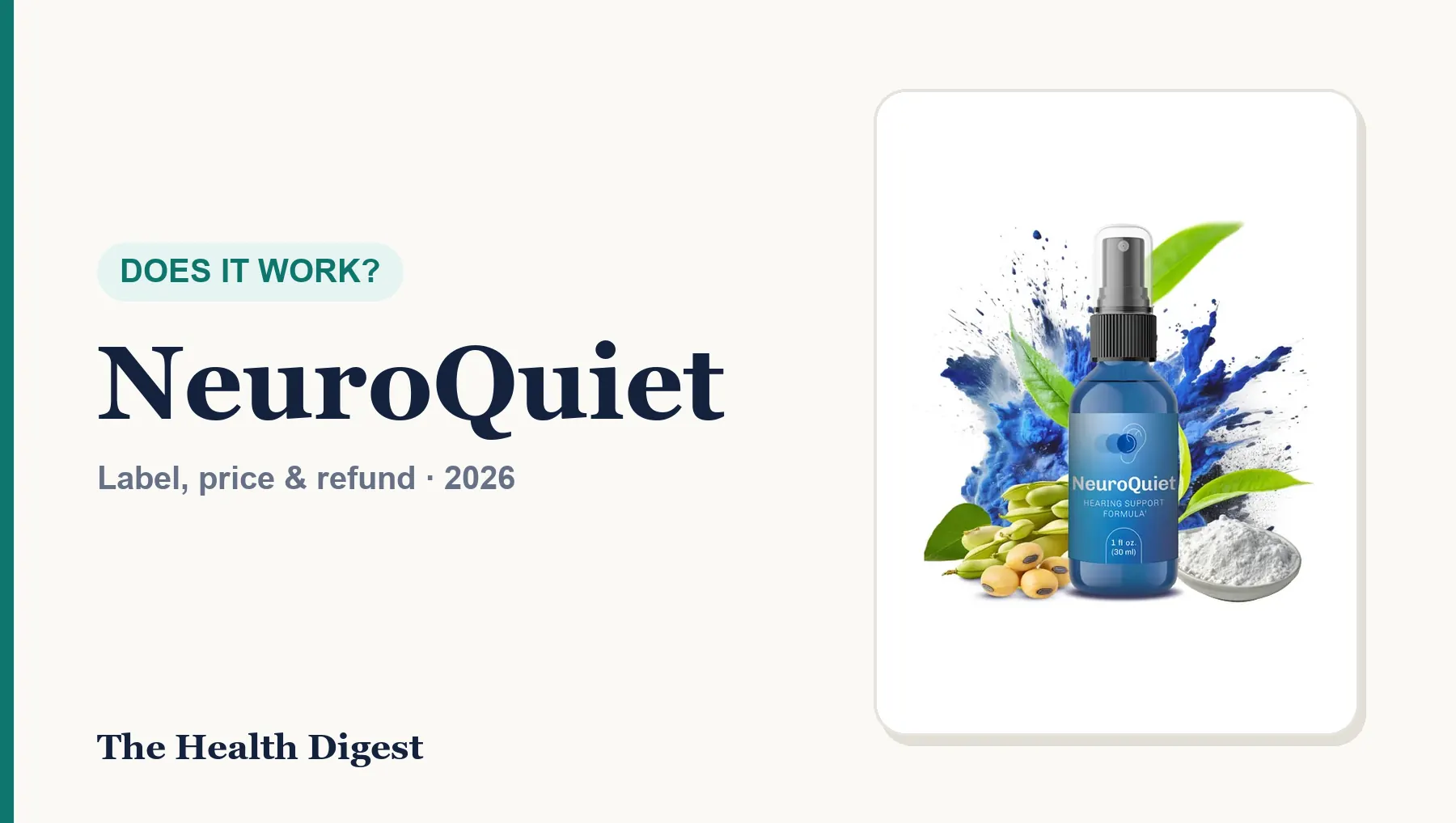
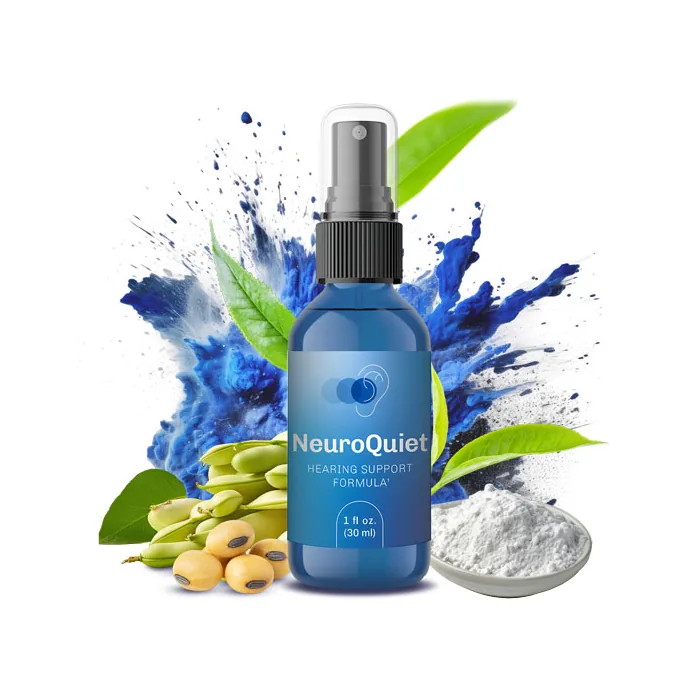
NeuroQuiet is a liquid supplement sprayed under the tongue, sold as a "Hearing Support Formula". Six sprays a day provide a 2000 ng "Growth Factor Complex" of alpha-GPC, GABA, L-dopa bean and moomiyo and a 1000 ng "HGA Blend" of ornithine alpha-ketoglutarate, glutamine, arginine, lysine, valine, isoleucine, tyrosine and glycine. It costs $49 to $79 per bottle as a one-time payment through ClickBank, with a 90-day money-back guarantee.
What "work" can mean here
| What you hope for | Realistic? |
|---|---|
| The ringing stops | ❌ No ingredient on the label has been shown to do this. |
| Better hearing | ❌ No evidence; hearing loss needs a hearing test. |
| Calmer mood or more energy | ❌ Unlikely at about 3 micrograms a day; the studies behind these ingredients use milligrams to grams. |
| Being less bothered by tinnitus | ⚠️ Possible for some people, mostly through expectation and routine; sound therapy and CBT have real evidence for this. |
The evidence, ingredient by ingredient
The four featured "growth factor" ingredients
The order page links alpha-GPC to brain health, GABA to relaxation, L-dopa bean to dopamine and moomiyo (shilajit) to vitality. In research, alpha-GPC is studied for memory and Alzheimer's disease, GABA for stress and sleep, L-dopa as a Parkinson's medicine and shilajit for fatigue. We found no human trial of any of them for tinnitus. The order page's reference to dopamine and tinnitus is a hypothesis paper, not a test of a treatment.
The amino acid blend
Ornithine alpha-ketoglutarate, glutamine, arginine, lysine, valine, isoleucine, tyrosine and glycine are studied for muscle, recovery, blood flow and, in some products, growth hormone. Nothing links them to hearing, and the studies use grams a day.
What has been tested for tinnitus
Ginkgo, zinc and melatonin have actually been tested for tinnitus, with disappointing or uncertain results. None of them is on the NeuroQuiet label.
Check NeuroQuiet price on the official site →Opens the brand's official website · money-back guarantee
The dose problem
This is the clearest issue. The label gives 2000 ng for four ingredients and 1000 ng for eight more, about 3 micrograms a day in total. Alpha-GPC alone is studied at hundreds of milligrams, and the amino acids at grams, so even a single ingredient in a study gets hundreds of thousands of times more than the whole NeuroQuiet serving. Taking it under the tongue does not close a gap of that size.
Same page, different label
NeuroQuiet's order page shares its FAQ answers word for word with the Audifort order page, including the claim that "once your body adapts to the ingredients you will notice less noise". The labels are different products: Audifort is a dropper whose 200 mg energy and metabolism blend matches EchoXen's, while NeuroQuiet is the nanogram spray described here. The same promise is attached to two unrelated formulas, which tells you it does not come from testing either one.
So why do some people say it helps?
Tinnitus is very sensitive to attention, stress and sleep. It often fades into the background with time, especially once a person learns it is not dangerous. A calm daily routine and the expectation of improvement can make the sound less bothersome for a while. That is real relief, but it is not the same as a supplement working, and it is why testimonials cannot settle the question.
If you want to try it, here is a fair test
- See a doctor or ENT first, and right away if your tinnitus is sudden, one-sided, pulsing or comes with hearing loss or dizziness.
- Rate your tinnitus from 0 to 10 for loudness and for how much it bothers you, once a week.
- Use the label dose of 6 sprays a day and change nothing else, including caffeine and noise exposure.
- After six to eight weeks, compare your ratings honestly.
- Decide well before day 60 so you are covered under every version of the refund policy.
The answer, stated plainly
NeuroQuiet is unlikely to work for tinnitus. Its label lists about 3 micrograms of ingredients a day, none of them tested for tinnitus, and the product itself has never been studied. If you want to try it anyway, treat it as an experiment covered by the 90-day refund, after your ears have been checked, and put most of your hope in the treatments that do have evidence.
Check NeuroQuiet price on the official site →Opens the brand's official website · money-back guarantee
Frequently asked questions
Is there a clinical trial of NeuroQuiet?
Not that we could find. The references on the order page are about the individual ingredients for cognition, mood, Parkinson's disease and exercise, not about tinnitus.
How long does NeuroQuiet take to work?
The FAQ says most people feel a difference after the first week and recommends three months or more. Neither figure comes from a study.
What does 2000 ng mean on the NeuroQuiet label?
ng is nanograms, billionths of a gram. 2000 ng is 2 micrograms, or 0.002 mg, shared by four ingredients.
Can NeuroQuiet restore hearing loss?
No. Nothing on the label has been shown to restore hearing. For hearing loss, a hearing test and, if needed, hearing aids are the proven route.
What actually helps tinnitus?
Treating causes such as earwax or a medicine side effect, hearing aids when there is hearing loss, sound therapy and cognitive behavioral therapy have the best evidence.
Related reading
 Review
NeuroQuiet review
What the NeuroQuiet label really lists, why its nanogram doses matter, what research says for tinnitus, who should ask a doctor first, what it costs and how the 90-day refund works.
Read more → Legit check
Is NeuroQuiet legit?
NeuroQuiet has a real ClickBank checkout, a published label and a 90-day refund. It also has nanogram doses and recycled sales copy. Here is how to weigh both before you pay.
Read more → Review
Does Audifort work?
We match every ingredient on the Audifort label with the research behind it, explain what the 200 mg blend means and show how to test it fairly.
Read more →
Buy it from the official store so the guarantee applies, and keep your order email until you decide.
Check NeuroQuiet price on the official site →Opens the brand's official website · money-back guaranteeSources
- NeuroQuiet official order page (neuroquiethq.com/c/order-now.php), homepage, Supplement Facts label image, FAQ, contact page, return policy, shipping policy and terms, plus the ClickBank order forms, accessed October 2026
- NIDCD: Tinnitus. nidcd.nih.gov/health/tinnitus
- NIDCD: Sudden Sensorineural Hearing Loss. nidcd.nih.gov/health/sudden-deafness
- MedlinePlus: Tinnitus. medlineplus.gov/tinnitus.html