MycosynX is a simple, honest-looking topical: a stated 5% undecylenic acid, a short list of familiar plant oils, a one-time price and 60 days to change your mind. It suits someone who wants a consistent at-home nail routine and understands that nails change over months, not weeks. What it is not is a tested or proven product, and it is no substitute for a diagnosis when a nail hurts, keeps spreading, or belongs to someone with diabetes.
What we like
- The active and its percentage are printed on the label
- Applied to the nail, so nothing is swallowed
- One-time payment with a 60-day money-back guarantee
- Short, readable ingredient list
Keep in mind
- No clinical trial of the finished serum exists
- Four applications a day takes real discipline
- The customer pays return shipping
Check MycosynX price on the official site →Opens the brand's official website · money-back guarantee
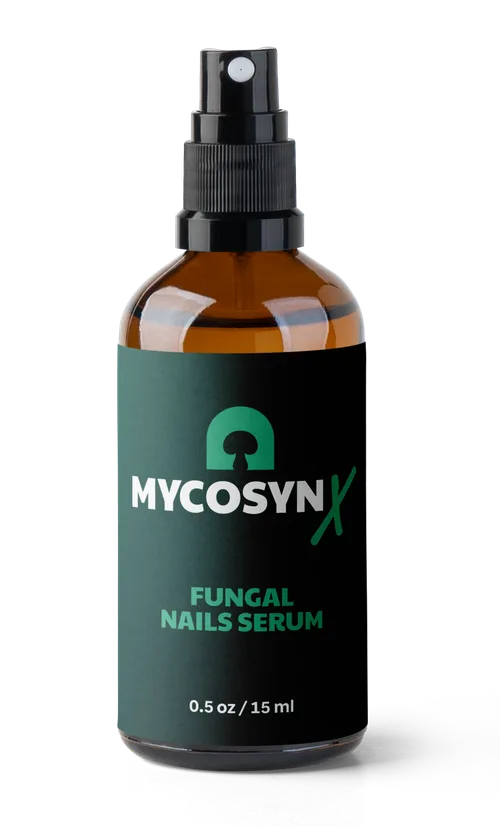
Before anything else, two facts. MycosynX is a topical serum you brush onto the nail and cuticle, 0.5 oz (15 ml), for external use only, with undecylenic acid USP at 5% as its stated active. And we found no published clinical trial of this serum, so nobody can truthfully tell you it works or that it fails. What follows is everything that can actually be checked: the clock nails run on, what is in the bottle, what research exists on the ingredients, why results differ, and how to use the 60-day guarantee sensibly.
Start with the clock, because it explains most of the disappointment
Nails do not heal. They grow out. A fingernail replaces itself over roughly six months; a big toenail can take a year or more. Whatever is happening at the base of the nail today will not reach the tip for a very long time, and the discolored or thickened part you can see now will still be there until it grows past the end and is trimmed away.
That single fact reframes the whole question. Any product applied to a nail, this one included, is judged over months. If you expect a different-looking toenail in three weeks, no topical will satisfy you. If you are willing to take a dated photo every month and compare the new growth near the cuticle rather than the old part at the tip, you will at least be measuring the right thing.
What the brand sells it for
The official order page markets MycosynX as "Healthy skin & nails, naturally" and as support for "your body's natural microbial balance", aimed at people bothered by yellow, thick or rough toenails and fingernails. The bottle says "For external use only" and "do not ingest". A few things on the sales pages we will not repeat as fact: a "Harvard scientists discover a white vinegar trick" hook, a figure about breaking down biofilms, a 2025 reference we could not verify, and the phrase "clinically proven". None of that reflects a test of this serum.
What is in the bottle
From the label on the order page (revision REV 0524), in label order: isopropyl palmitate, undecylenic acid USP (5%), almond oil, flaxseed oil, tea tree essential oil, aloe vera leaf extract, DL-alpha tocopherol acetate (vitamin E), lemongrass oil and lavender oil. Directions: apply four times a day, twice in the morning and twice in the afternoon, brushing the nail surface and working it into the cuticle with a cotton swab, with gentle filing suggested. Distributed for MycosynX, Largo, Florida; "Assembled in the USA".
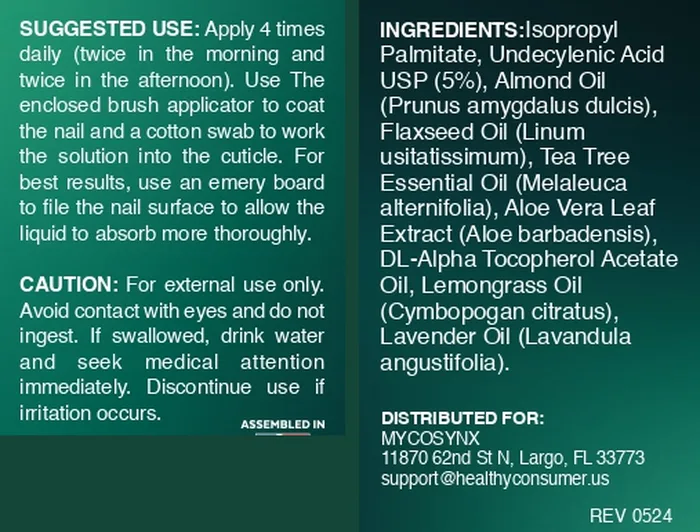
Note what the label is not: there is no "Drug Facts" panel on it, so its regulatory status is not something we were able to verify. Our full MycosynX review also covers the older 1 oz spray still shown on the homepage, which has a different formula; the serum above is what the order page sells.
Undecylenic acid, neutrally
Undecylenic acid is a fatty acid derived from castor oil and a long-established topical antifungal ingredient: it appears in the FDA's over-the-counter monograph for athlete's foot and ringworm, and it has been sold in foot products for decades. That is a statement about the ingredient, not about this bottle. Skin and nail are different problems, which brings us to the next point.
The part that makes nails hard
The nail plate is dense keratin, and topical products in general penetrate it poorly. This is the reason nail problems are slow to respond to anything applied on top, and why an emery board is suggested on the label: thinning the surface is an attempt to help a topical reach further. A 2024 laboratory study compared how prescription and over-the-counter nail antifungals behave on nail samples, which is the kind of work that measures penetration. Again: an ingredient-level finding, not a result for MycosynX.
Tea tree oil and the other oils
The NCCIH says there is a small amount of evidence for tea tree oil in athlete's foot, possibly weaker than standard treatment, and that for nail fungus "the amount and the quality of the research are insufficient". Lavender has no good evidence for nails and the NCCIH notes that topical use can irritate skin. Almond, flaxseed, lemongrass, aloe and vitamin E are conditioning and fragrance components; their practical job is to keep the serum spreadable and the cuticle area soft.
Check MycosynX price on the official site →Opens the brand's official website · money-back guarantee
Has MycosynX itself been studied?
No. We searched for a clinical trial, a registered study or a third-party test of the finished serum and found nothing. The brand's own claims of being "clinically proven" are not backed by anything we could locate, and the sources it cites are either about ingredients or, in one case, a reference we could not verify at all. Treat every "X% effective" number you see about this product as marketing until a study exists.
The name mix-up that sends people to the wrong product
Search for "MycosynX" and most of what comes back is Mycosyn Pro, an older and completely unrelated product that is taken by mouth, sold through a crowd of look-alike "official" domains such as en-mycosynpro.com, en-us-mycosynpro.com, mycosynpro-us.com and mycosynpromycosyn.com, plus a layer of spam review pages. It is a different company, a different format and a different formula.
This matters for the "does it work" question in a practical way: a great many reviews, complaints and success stories that appear under the MycosynX name are actually about Mycosyn Pro. If you are weighing up what other people experienced, first check which product they were using. The test is simple: MycosynX is brushed onto the nail and sold on mycosynx.com. If a page asks you to swallow something or the domain contains "mycosynpro", it is the other product. We break the domains down in is MycosynX legit.
Why results differ so much between people
Even with proven nail treatments, outcomes vary widely. The reasons are worth knowing before you judge any bottle:
- It may not be fungus. Psoriasis, repeated trauma from shoes or sport, and other conditions produce nails that look identical to the untrained eye. Diagnosis requires a test.
- Fingernails and toenails behave differently. Fingernails grow faster and are easier to reach; big toenails are the slowest and thickest.
- How much of the nail is affected, and whether the base near the cuticle is involved.
- Circulation, age and diabetes, all of which slow nail growth.
- Consistency. Four applications a day, every day, for months is a demanding routine, and partial use is the most common reason a topical goes nowhere.
- Reinfection. Shoes, gym floors, shared showers and untreated athlete's foot on the skin can restart the problem.
Sixty days of guarantee, twelve months of nail

Every order from the official MycosynX store is covered by a 60-day money-back guarantee, and it is a one-time payment with no subscription.
The guarantee runs 60 days from the order date, and it is genuine, but be clear-eyed about the mismatch: 60 days is not enough time for a toenail to grow out. So decide in advance what you will judge at day 50, and make it something honest and observable rather than a cure:
- Photograph the nail on day one, same light, same angle, with a ruler or coin in frame for scale.
- Mark the border of the discolored area lightly with a file so you can see later whether it has moved.
- Apply as the label says, on clean dry nails, and track whether you actually managed four times a day. If you did not, that is your answer about fit.
- At day 50, compare the photos and ask two questions: is the new growth at the base any different, and has the affected area spread?
- If the answer is no, or the routine is not realistic for you, start the refund while the window is open rather than hoping.
Refund mechanics: contact support first (support@mycosynx.com on the order page, support@healthyconsumer.us on the support page, or +1 (877) 257-0825), then return all bottles, including empty ones, to MycosynX, 11870 62nd St N, Largo, FL 33773. The customer pays return shipping. Refunds are listed as 5 to 10 business days on the support page and 3 to 5 in the terms.
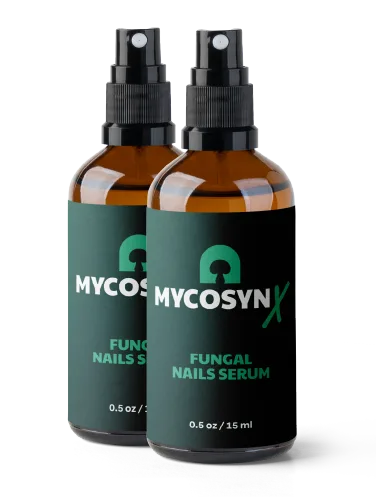 2 bottles60-day supply$79 /bottle$158 · + shippingCheck availability →Best value
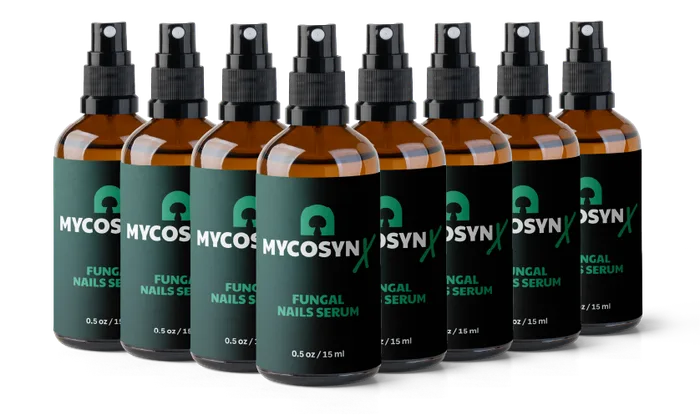 6 bottles180-day supply$49 /bottle$294 · free shipping + bonusesCheck availability →
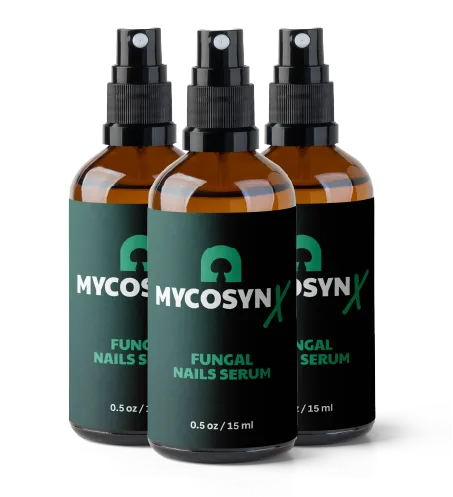 3 bottles90-day supply$69 /bottle$207 · + shippingCheck availability →
Buying note that follows directly: the 6-bottle package is the cheapest per bottle and ships free, but it commits you well past the 60 days you can act on. If you are testing rather than committing, the smaller package fits the window better.
When to stop and see a doctor or podiatrist
Some nails should be looked at by a professional before you buy anything at all:
- Pain in or around the nail, or swelling, redness, warmth or pus.
- Spreading: more nails affected, or the skin around them involved.
- Diabetes or poor circulation. The NIDDK advises that any foot or nail problem be checked, because small problems escalate quietly.
- A dark streak or band under a nail, especially a new one or one that is widening. This needs assessment promptly; melanoma can present this way.
- No improvement over months, which usually means the diagnosis, not the product, is the issue. The American Academy of Dermatology explains what testing and treatment involve.
Also patch-test or skip it if you have a tree-nut allergy (the serum contains almond oil) or sensitive skin: tea tree, lemongrass and lavender can cause contact dermatitis, and an allergic reaction to an undecylenic acid nail solution has been reported in the literature. Keep it out of eyes and mouth, and stop at the first sign of irritation.

Bottom line
Does MycosynX work? Untested, and therefore unknown. The label is clear, the active ingredient is a familiar one, the routine is demanding, the price is one-time and the 60 days are real. Judged as a careful at-home nail-care routine with modest expectations and a monthly photo, it is a reasonable thing to try. Judged as a cure on a two-month deadline, it was never going to satisfy anyone, and a nail that hurts, spreads or carries a dark streak belongs in a clinic, not in a shopping cart.
Check MycosynX price on the official site →Opens the brand's official website · money-back guarantee
Frequently asked questions
Is there a study showing MycosynX works?
No. We found no clinical trial, registered study or third-party test of the finished serum. The research that exists is on individual ingredients such as undecylenic acid and tea tree oil.
How long does MycosynX take to show anything?
Nails grow out over about six months for fingernails and up to a year or more for big toenails, so any visible change is slow. Compare the new growth at the base, not the old part at the tip.
Is MycosynX swallowed?
No. It is applied to the nail and cuticle with a brush or swab. The label says external use only and warns against ingesting it.
Is MycosynX the same thing as Mycosyn Pro?
No. Mycosyn Pro is a different, older product taken by mouth and sold on unrelated domains. Many reviews found under the MycosynX name are actually about Mycosyn Pro.
What if my nails look no different after two months?
That is within the normal timescale for nails, but the guarantee closes at 60 days from your order date, so decide before it expires. The customer pays return shipping.
When should I see a doctor instead?
If the nail hurts, the problem is spreading, you have diabetes or poor circulation, or a dark streak appears under the nail, see a doctor or podiatrist rather than relying on any at-home product.
Related reading
 Legit or scam?
Is MycosynX legit or a scam?
Most of the doubt around MycosynX comes from a name clash with Mycosyn Pro and from an official site that still shows an older spray. Here is how to confirm you are buying the real nail serum.
Read more → Review
MycosynX review
MycosynX is not something you swallow. It is a 0.5 oz serum you brush onto the nails and cuticles. Here is what the label lists, how it is meant to be used, what it costs and how the refund works.
Read more → Review
Does RagnarOak work?
No study has tested the RagnarOak gummy. What can be examined is the label, the research on each botanical in it, and how to judge the product for yourself inside the guarantee window.
Read more →
Buy it from the official store so the guarantee applies, and keep your order email until you decide.
Check MycosynX price on the official site →Opens the brand's official website · money-back guaranteeSources
- MycosynX official order page, product label (REV 0524), homepage, support page and terms (mycosynx.com), accessed September 2026
- NCCIH: Tea Tree Oil. nccih.nih.gov/health/tea-tree-oil
- NCCIH: Lavender. nccih.nih.gov/health/lavender
- Ex vivo comparison of prescription and over-the-counter nail antifungals, 2024 (PubMed). pubmed.ncbi.nlm.nih.gov/39133361
- Allergic contact dermatitis from an undecylenic acid nail solution (PubMed). pubmed.ncbi.nlm.nih.gov/30537336
- American Academy of Dermatology: Nail fungus treatment. aad.org/public/diseases/a-z/nail-fungus-treatment
- NIDDK: Diabetes and foot problems. niddk.nih.gov/.../foot-problems